
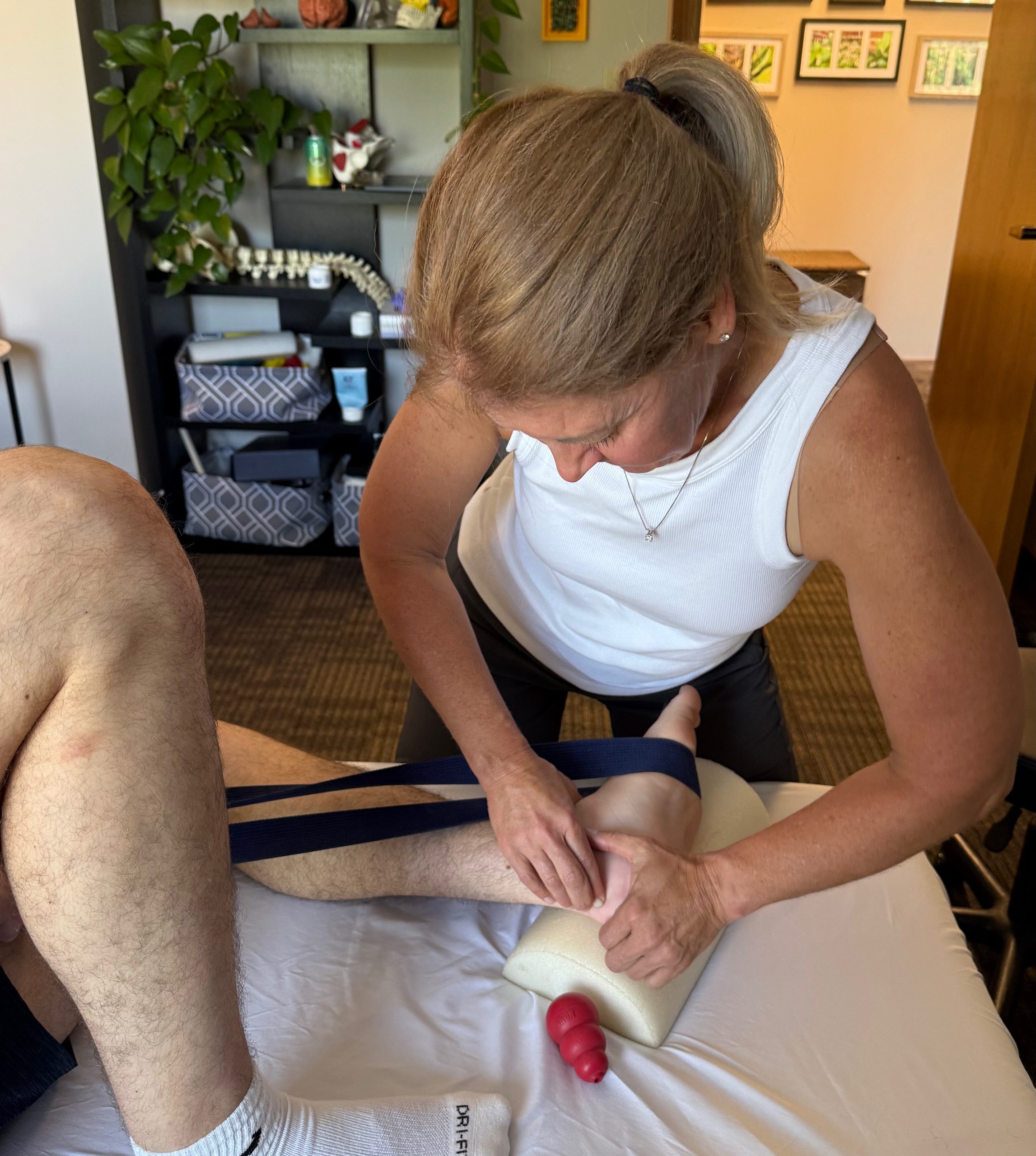

This is important to share (as most things that support health and humanity are)… Blisters hurt! It hurts to wear shoes. It hurts to walk and run. There is a risk of infection. And they take time to heal.
Blisters are not a typical thing people ask for my help with. Although I did have one woman who was preparing for an out of the country hiking trip. She had experienced my work before and wondered if there was anything I could do to help her decrease rubbing in her boots with the hopes of avoiding painful blisters.
Absolutely.
And now I am pulling out the moleskin for my high school soccer player…
He is doing a PHENOMENAL job of learning how to take care of his body. He is foam rolling, learning how to engage his feet and optimize his alignment as he builds functional strength in the gym. He is much more aware of his sitting posture and how harmful it has been in the past.
And his knees no longer hurt.
His speed and agility is improving exponentially.
His confidence is growing.
…and he played his big boy heart out the other day and now is nursing blisters!
It didn’t surprise me at all. His pelvis is moving more efficiently taking the strain off his knees, but there is still mechanical restoration and retraining needed.
Most things, pain things, wear and tear things outside of a direct injury, overuse things, are due to the body’s need to compensate.
I see this when I watch every single person walk. If there are areas of the body that don’t move well, which there always are, the body will find another place to try to gain that motion. This is my working Trauma Compensation Theory, which makes all the sense in the world once we break the pieces down.
I see compensations result in excess strain on: the hips, the low back, the neck, the shoulders, elbow, the achilles and plantar fascia, feet, really anywhere. These compensations over time become: degeneration, tears, tendonitis, spurs, bunions, stress fractures, and more acutely, blisters.
When my boy runs, he has a compensatory “pivots” through his feet – pushing off the outside of his big toe, one side more than the other due to the hip and pelvis having asymmetrical inefficiencies. Left untreated, he will likely develop a callus in response to the force.
Does this have to be his destiny? Painful blisters, callouses, and eventually wicked bunions or who knows what joints the compensations will settle into next?
Absolutely not!
We will progress his mobility, alignment, and stability work. Improve the joint mobility and gait retraining through my hands-on work. He will develop the awareness of when he is walking and running efficiently and when his is not…in which he will now have the skill set to reset his body into better efficiency.
It’s beyond exciting.
And it’s available to everyone.
This is why I created the sequence in The Engage Method. I teach awareness of how your body moves and feels, how to effectively help you regain your mobility AND stability, which translates into efficient movement in all that do – especially with walking and running. It’s powerful – and should be in every PE class, rec center, and in the skillset of every athletic trainer. It’s foundational work that every human needs to master to live a live with less degeneration, pain, and injury.
What can you do in the meantime? Start to notice how you walk, look at your feet, do you have callouses? Have you had any injuries in the past? It begins with curiosity and awareness.