
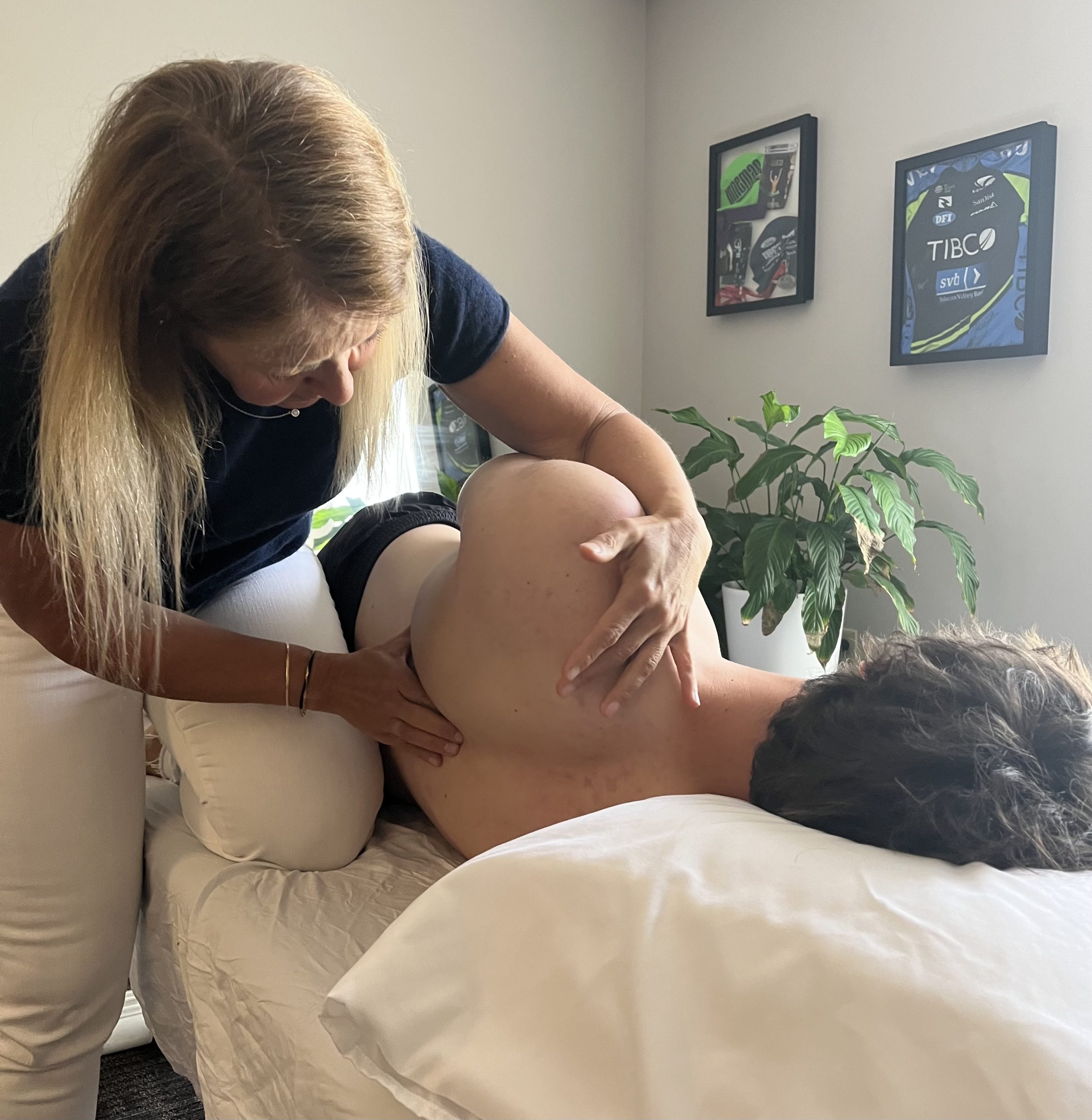

I ran into one of my favorite high school humans at our homecoming pep rally. Knowing swimming is his primary sport, I asked if he’d been in the water.
“Just a little bit. My shoulder is still bothering me.”
“That’s been bothering you since last season… what are you doing for it?”
“Going to PT, doing exercises… my trainer just gave me some new ones.” Then he showed me classic internal and external rotation exercises with bands.
What I saw
These days, it takes me only minutes, if not seconds, to see the imbalances of structure and alignment in a body. And I had watched him swim last season.
There is tightness in his mid back, most likely from a combination of sitting all day at school and in cars, and from strengthening his chest in a flexed, forward position. This thoracic position (upper back and chest) makes it impossible for his shoulder blade to get into a better position, which in turn puts his shoulder in a not-so-great position.
Then this amazing kid gets in the pool for reps, or in the gym for strengthening…
The tug of war
He is doing so on a system that can’t fully accept and distribute the motion of each stroke he takes or each rep with weight. It’s a game of tug of war, and the body will always find another way to get motion, often at the expense of another joint.
And those joints were NOT designed to handle excessive motion and load for years.
Beyond the diagnosis
Unfortunately, most practitioners are looking at what the problem is, or trying to find a diagnosis. Is it tendinitis or tendinosis? For sure there is an inflammatory process in the tendon. Standard treatment for tendonitis is rest, anti-inflammatories (which are very hard on the liver, kidneys, and digestive system), maybe laser or ultrasound, and exercise to strengthen.
But when he is doing “all the things” and not getting better, we have to ask the next right questions and look at the bigger picture: why is that tendon irritated? Someone may say it’s too much swimming. But there are swimmers who never get tendinitis, right?
We have to look at movement and function. Does the body have the capacity and availability to move optimally through space without needing compensatory movements?
Back to my swimmer buddy: if his back doesn’t have adequate rotation (critical for swimming), he will need to find it somewhere else, adding even more strain to a shoulder that already sits too far forward. The ball of the shoulder, with its capsule, tendons, and ligaments, should sit and spin, not slide forward and backward with each stroke or exercise.
Alignment and stability, then strength
It’s about alignment and stability. THEN you can, and must, build strength.
You can’t have alignment if you don’t have the mobility to get there. We have to look at the whole person, and the whole person during movement. It’s really quite simple:
- Where do they not move well?
- Where do they compensate to get the motion they need?
Too much compensation puts too much demand on a joint, and that results in wear and tear. Sadly, that is the driver of most of the degenerative orthopedic conditions I see.
The good news
The sooner we can bring the body to a better state of balance, alignment, mobility, stability, and strength, the more joints we can save, and the longer people keep enjoying their sports and activities.
For clinicians
I teach all of this and more in my mentorship, and I post on YouTube, social media, and my website. We are currently in session, and enrollment for next year opens in November. Stay tuned to learn more.
For patients
Want to be my patient? I have a long waitlist, but you can get started on my teaching and instruction through my programs. You can find everything at www.tscfih.com.
There is hope for healing.
Jen